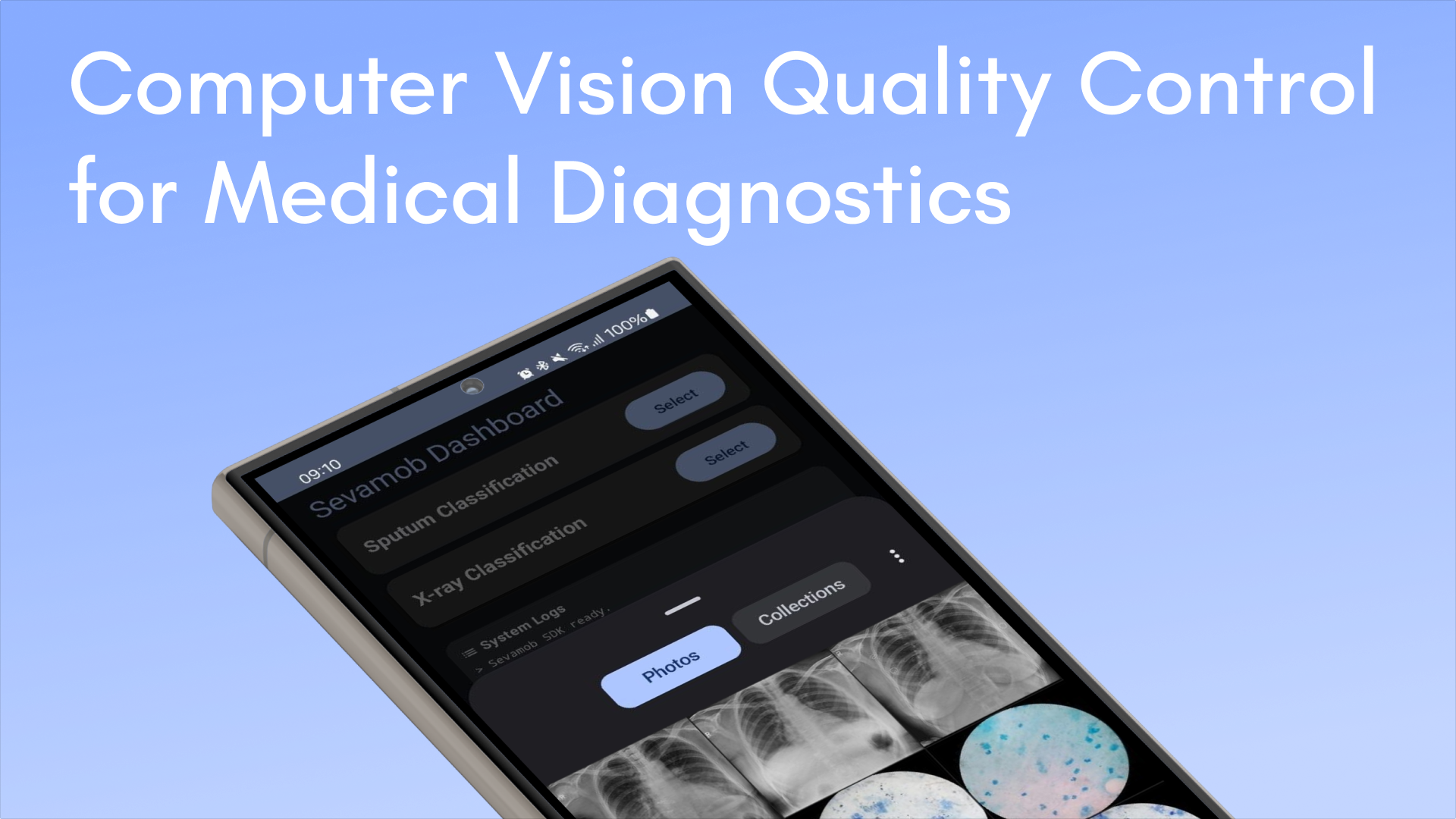
Computer Vision Quality Control for Medical Diagnostics
In a 4-week R&D sprint, we built an offline machine learning engine and SDK to implement sub-second diagnostic image quality assessment on medical devices.

Duration
4 weeks

Industry
Diagnostics, Screening

Services
Mobile App Development
Overview
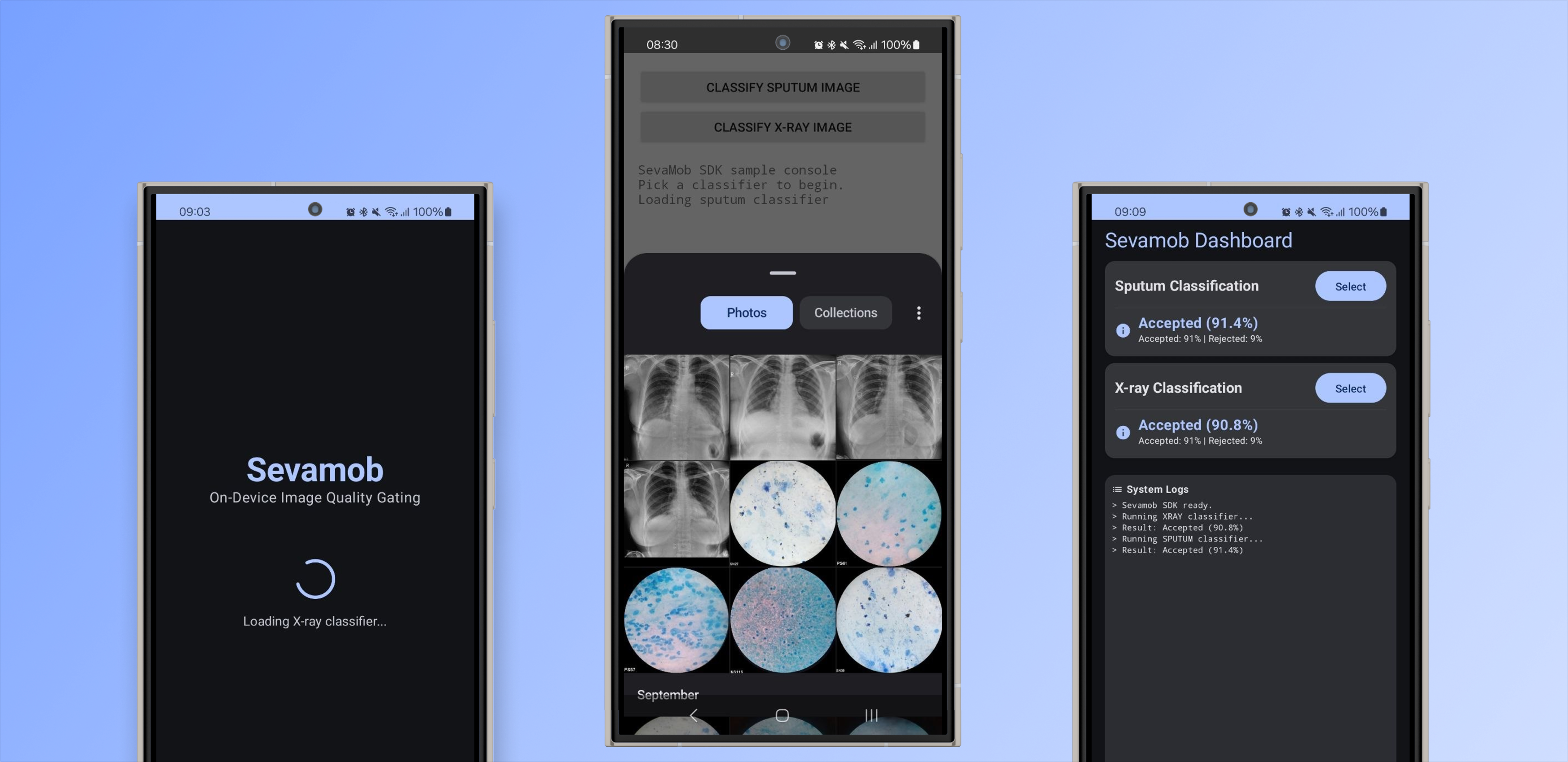
Sevamob is an AI-assisted disease management platform that equips frontline health workers with mobile screening tools. Their operational devices analyze clinical imagery across multiple specialties, including sputum microscopy and chest X-rays, to screen for medical conditions.
Bad lighting, blur, and overexposure can easily ruin these images before diagnostic models ever see them. To catch these issues early, we built an offline Quality Control (QC) system that runs directly on mobile hardware. It gives immediate pass/fail feedback before images move to full diagnostic processing.
Challenges of Small Datasets
Modern deep learning models excel on large image datasets, but struggle in clinical quality assurance where data is limited and diagnostic criteria are non-linear.
- Data scarcity: Neural networks need massive datasets to generalize properly. With only a few hundred images available, the models just memorized our training photos instead of learning how to spot defects in unseen ones.
- VLMs: Multimodal models like MedGemma and PaliGemma failed because they were pre-trained for pathology or standard photos, not technical quality checks. Adjusting them required computing power and missed latency targets, while fine-tuning didn’t help much and synthetic data augmentation failed to produce realistic new defect types.
- Prompts: Strict prompts caused models to reject almost every image, whereas softened prompts caused them to miss defective samples entirely (so called confirmation bias).
- Structural defects: While quality assurance often focuses on simple visual artifacts like blur or exposure, our research revealed that the primary cause for sputum slide rejection was presence of saliva in samples, a subtle pattern that standard image filters and neural networks often mistook for normal anatomy.
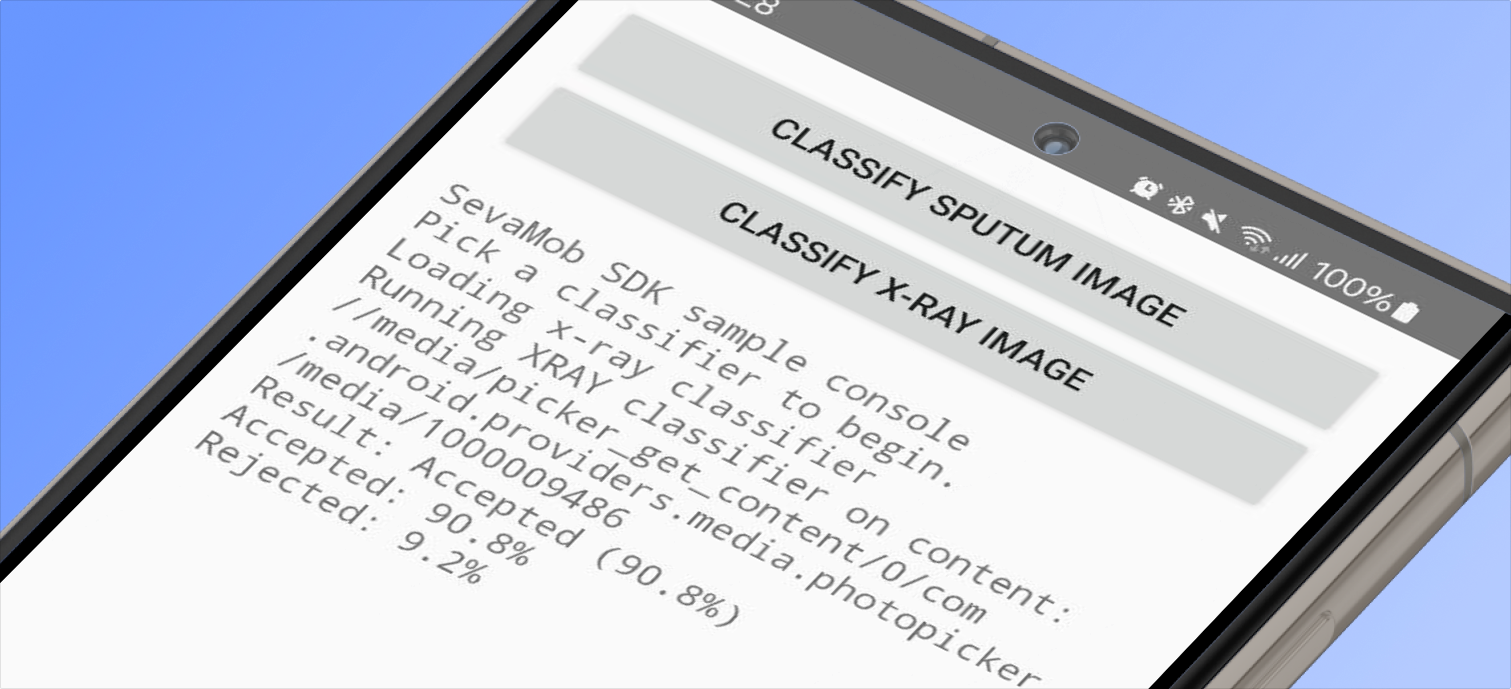
Lightweight Machine Learning
Instead of forcing heavy AI models into a tight mobile environment, we switched to simple, focused machine learning tools:
- For sputum microscopy, we built a Gradient Boosting classifier operating on 14 fixed mathematical features extracted via OpenCV.
- For chest X-rays, we started from high-dimensional neural networks, but they quickly proved overly complex on the provided dataset. We built a One-Class Isolation Forest algorithm instead, focusing on 5 core optical metrics to catch technical flaws without getting distracted by anatomical noise.
- Additionally to a pass or fail output, we built probability score controls into the inference engine so teams can adjust decision thresholds to their operational environments.
Results
The quality control engine delivered a fast, reliable testing baseline built specifically for mobile hardware:
- Speed: Sputum microscopy response took just 120 ms, which general-purpose AI models cannot achieve on offline mobile hardware.
- Accuracy: The Sputum model hit 83% accuracy on field data, while the X-ray model needs more real-world images to improve its performance.
- 4-Week Delivery: Verified the dataset, selected models, engineered the pipeline, tested and packaged the SDK within the R&D sprint.
Testimonial
“26bitz selected a model, performed training and testing, developed an Android app and did handover with appropriate documentation. They met all project milestones on time. They were very responsive and addressed all our needs.” — Shelley Saxena, Founder & CEO of Sevamob
What’s Next
Sevamob will fine-tune the algorithms as new field samples come in, then integrate the ML engine directly into their mobile devices to test how it handles live clinical workflows.
Technology stack
Python, Kotlin, OpenCV, Android SDK
Start building your future-ready
solution today
We're here to help you with your inquiries.
Customer testimonials
Our clients highlight our expertise and reliable technical support
26bitz immediately understood our vision for bringing accessible mental health support to this vulnerable population. Utilizing a model fine-tuned on Swahili language will expand the number of students who can access Tumaini and make interactions feel more organic and natural. We look forward to continuing to work with 26bitz to expand the features and functions of Tumaini to better serve the mental health needs of Youth with Disabilities.
Chris
Harrison
Working with Andrey and 26bitz was a great experience. They jumped in quickly to help us set up an integration in our internal pharma system and brought valuable insights from their experience in healthcare tech. Their knowledge of security and compliance really stood out, and it was super easy to communicate with them. Would definitely work with 26bitz again!

Victor G.
Affairs Manager

26bitz has finalized the Supabase migration, and the entire app now runs on a custom backend. The team has set up the cloud infrastructure and deployed the app; it's now fully up and running. 26bitz has significantly improved application speed and loading times; it's now much faster. I'm impressed by 26bitz's clarity, quickness, and kindness. They've been amazing.

Eric Talbert
What stood out most about 26bitz was the rare combination of technical innovation and genuine compassion that drives their work. Finding a technology partner who not only excels in software development but also demonstrates a deep commitment to social impact and mental health advocacy is truly uncommon. The collaboration with 26bitz was seamless from start to finish. Communication, delivery, and professionalism consistently exceeded expectations, and all project goals were achieved on time and with exceptional quality.

Joel Finch
of Directors Chair.


Latest Case Studies
Explore our latest challenges and successes in building impactful healthtech solutions.
.avif)

Schedule a consultation with our team
Please provide a brief overview of your project and your earliest availability, and we will get back to you as soon as possible.